Digital Emergency Ham Radio Network
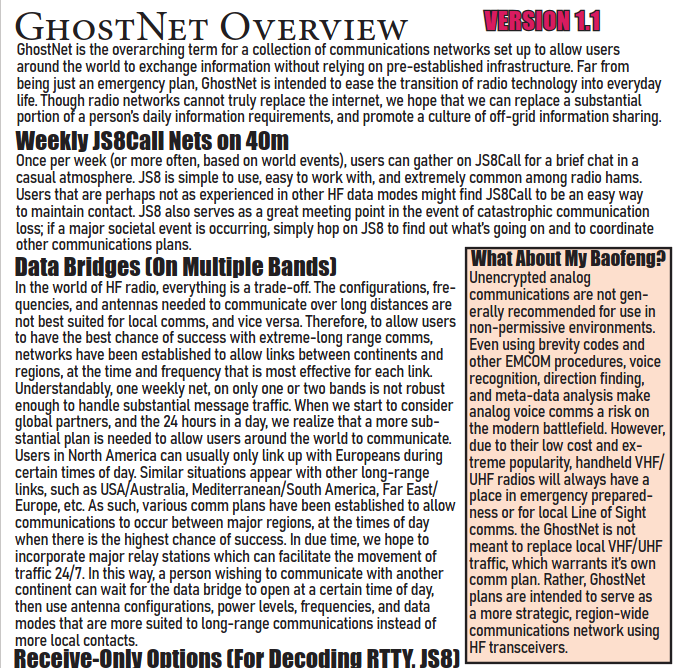
GhostNet is the overarching term for a collection of communications networks set up to allow users
around the world to exchange information without relying on pre-established infrastructure.
While you can listen using a rtl-sdr dongle, a technician license does not allow transmitting on the primary Ghostnet 40-meter band.
Holds weekly "comm windows" for global coordination, with optional pre-comm checks to avoid congestion.
Promotes operational security (OPSEC) and peer-to-peer communication without centralized control.
Set up JS8Call with your SDR and radio.
Tune to 20m or 40m bands (commonly used for GhostNet).
Use @GN(Country)(State) callsigns (e.g., @GNUSASC for South Carolina) to identify regional groups.
Join weekly GhostNet nets (often on Thursday evenings at 9 PM Eastern).
Technology:
Built on JS8Call, RTTY, and Winlink, leveraging existing ham radio hardware and protocols. It uses data bridges to connect HF bands with internet-based services, allowing messages to be sent even if the internet is down.General class license
Effective use of Ghostnet needs a General class license or higher.While you can listen using a rtl-sdr dongle, a technician license does not allow transmitting on the primary Ghostnet 40-meter band.
Structure:
Operates on specific frequencies like 7.078 MHz (JS8Call) and 7.075 MHz (RTTY).Holds weekly "comm windows" for global coordination, with optional pre-comm checks to avoid congestion.
Promotes operational security (OPSEC) and peer-to-peer communication without centralized control.
How to Get Started:
For Licensed Operators:Set up JS8Call with your SDR and radio.
Tune to 20m or 40m bands (commonly used for GhostNet).
Use @GN(Country)(State) callsigns (e.g., @GNUSASC for South Carolina) to identify regional groups.
Join weekly GhostNet nets (often on Thursday evenings at 9 PM Eastern).
ALE
Automatic Link Establishment (ALE) is a technology used in HF radio communications to automatically establish and maintain radio links between stations. It allows radios to scan for the best frequencies and establish communication without manual tuning, making it ideal for emergency communications and situations where quick setup is essential. ALE can be used in conjunction with GhostNet to enhance connectivity and reliability in digital ham radio networks.Ghostnet Radio Settings
- 1.1 Volume: ~10
- 1.2 Mode: USB
- 1.3 Filter BW: Full
- 1.4 Band: 40m
- 1.5 Tuning Steps: ??
- 1.6 VFO Mode: A
- 1.7 RIT: Off
- 1.8 AGC: On
Docs
Bands
- 20 Meters: Offers long-range communication capabilities, often used for intercontinental contacts. Ideal for global coordination and reaching distant stations.
- 40 Meters: Provides regional communication capabilities, with better propagation during the day and night. Suitable for local and regional nets.
- VHF/UHF: Used for short-range communication, often within a city or local area. Ideal for tactical operations and close-range messaging.
20 Meters
- 20 Meters: Offers long-range communication capabilities, often used for intercontinental contacts. Ideal for global coordination and reaching distant stations.
The network's 20m frequency (14.107 MHz) is primarily designated for data bridges and longer-range, international communications, complementing the regional 40m (7.107 MHz) sub-bands.
TOC
Tactical Operations Center (TOC)A ham radio TOC serves as the central command node
during public service events, search and rescue operations, or disaster response.
It integrates multiple radios, computers, and logging systems to track field teams
and relay intelligence
40 Meters
How the 40m GhostNet Works
- Core Software: Participation requires a computer connected to an HF transceiver using the JS8Call application.
- Frequencies: The 40-meter band is commonly used for GhostNet communications, with specific frequencies like 7.078 MHz USB designated for JS8Call traffic.
- Group Tags: Users identify themselves with group tags (e.g., @ghostnet) to facilitate communication and coordination within the network.
- Scheduling: GhostNet hosts regular nets, often on Thursday evenings at 9 PM Eastern, where participants exchange information and check in.
- OPSEC: The network emphasizes operational security, encouraging users to communicate directly without relying on centralized servers or infrastructure.
Plan
The GhostNet plan is a comprehensive strategy for establishing
and maintaining a resilient, decentralized communication
network using amateur radio technologies. It outlines the
technical infrastructure, operational protocols, and community
engagement necessary to create a robust digital emergency
communication system that can function independently of
traditional internet and cellular networks. The plan includes
details on frequency allocation, software requirements,
training programs, and coordination efforts to ensure
effective communication during emergencies and disasters.