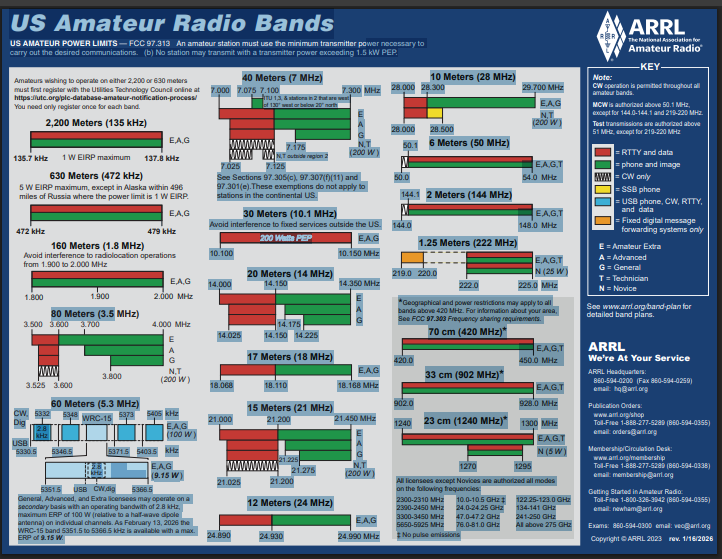
2 Meters (144-148 MHz)
| 144.00-144.05 | EME (CW) |
| 144.05-144.10 | General CW and weak signals |
| 144.10-144.20 | EME and weak-signal SSB |
| 144.200 | National calling frequency |
| 144.200-144.275 | General SSB operation |
| 144.275-144.300 | Propagation beacons |
| 144.30-144.50 | New OSCAR subband |
| 144.50-144.60 | Linear translator inputs |
| 144.60-144.90 | FM repeater inputs |
| 144.90-145.10 | Weak signal and FM simplex (145.01,03,05,07,09 are widely used for packet) |
| 145.10-145.20 | Linear translator outputs |
| 145.20-145.50 | FM repeater outputs |
| 145.50-145.80 | Miscellaneous and experimental modes |
| 145.80-146.00 | OSCAR subband |
| 146.01-146.37 | Repeater inputs |
| 146.40-146.58 | Simplex |
| 146.52 | National Simplex Calling Frequency |
| 146.61-146.97 | Repeater outputs |
| 147.00-147.39 | Repeater outputs |
| 147.42-147.57 | Simplex |
| 147.60-147.99 | Repeater inputs |
Std Repeater Offset either +6 or -6 MHz
The SSB portion of the band runs from 144.100 MHz to 144.275 MHz and Upper Sideband (USB) is used. The 2M SSB calling frequency is 144.200 MHz, so that is the first place to look for activity or to call CQ. One of the realities of 2m SSB operation is that many times, no one is on the air. There is just not that much activity out there, compared to 2m FM. Some amateurs get discouraged, turn off the radio and and miss the thrill of working distant stations during a band opening. To get started on 2m SSB, the trick is to get on the air at times when you know there will be activity— during VHF nets and VHF contests.70 Centimeters (420-450 MHz)
| 420.00-426.00 | ATV repeater or simplex with 421.25 MHz video carrier control links and experimental |
| 426.00-432.00 | ATV simplex with 427.250-MHz video carrier frequency |
| 432.00-432.07 | EME (Earth-Moon-Earth) |
| 432.07-432.10 | Weak-signal CW |
| 432.10 | 70-cm calling frequency |
| 432.10-432.30 | Mixed-mode and weak-signal work |
| 432.30-432.40 | Propagation beacons |
| 432.40-433.00 | Mixed-mode and weak-signal work |
| 433.00-435.00 | Auxiliary/repeater links |
| 435.00-438.00 | Satellite only (internationally) |
| 438.00-444.00 | ATV repeater input with 439.250-MHz video carrier frequency and repeater links |
| 442.00-445.00 | Repeater inputs and outputs (local option) |
| 445.00-447.00 | Shared by auxiliary and control links, repeaters and simplex (local option) |
| 446.00 | National simplex frequency |
| 447.00-450.00 | Repeater inputs and outputs (local option) |
Std Repeater Offset - 5MHz
Some areas of the country use + 5 MHz offset while others use - 5 MHz.The 70 cm band is BIG…providing 30 MHz of spectrum compared to only 4 MHz on 2 Meters.
SSB is the preferred voice mode for so-called “weak signal” operators. The mode is more efficient than FM when signals are weak, so it is the way to go when you are trying to push the limits of 70 cm DX.
The channel spacing needs to be at least as wide as the bandwidth of the signal, which allows room for each signal without interfering with the adjacent channel. The vast majority of the country uses 25-KHz spacing for FM repeater and simplex channels. Some areas, most notably parts of California, have chosen to use a 20-kHz channel spacing.
Simplex
Choosing an appropriate simplex frequency can be a little tricky, since local practice varies. Across all of North America, 446.000 MHz is the National Simplex Frequency (also referred to as the calling frequency). In most places, the channels immediately adjacent to 446.000 MHz are used as simplex frequencies, spaced by 25 kHz. This means that 445.925, 445.950, 445.975, 446.025, 446.050, 446.075 MHz are all valid simplex frequencies. But other areas have assigned these frequencies to repeater operation.10 Meters (28.000-29.700 MHz) - Tech:200W Max, General:1500W

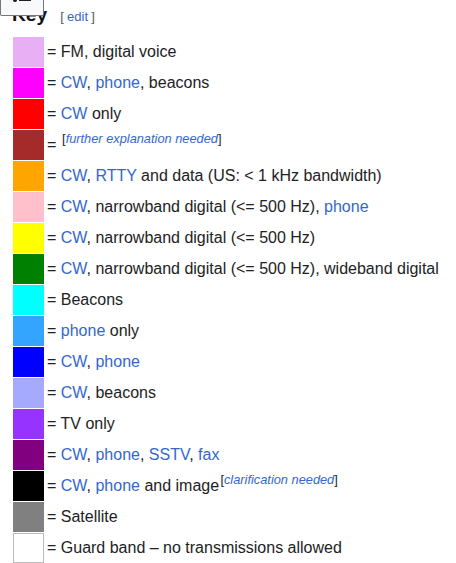
28.025 CW Rare DX & DXpeditions Frequently Operate Here — Split
28070.15 PSK-31 (offset -115 for USB)
28.080 RTTY Rare DX &
DXpeditions Frequently Operate Here — Split
28.1010 10/10 Intl CW Calling Frequency
28120.150 — PSK31
28.120-28.300 Beacons
28.380 10/10 SSB Intl Calling Frequency
28.425 10/10 SSB Intl Calling Frequency
28.495 SSB Rare DX & DXpeditions Frequently Operate Here — Split
28.600 Old General Callin Frequency - Still used by Old Timers
28.675~28.685 SSTV Operating Frequency — IARU Region 1
28.680 SSTV Operations USA/Canada
28.825 10-10 Backskatter Net - Paper Chasers Net
28.885 6M DX Liaison Frequency — Listen here for 6 Meter DX opening announcements and discussions.
28.945 FAX Operating Frequency
29.000-29.200 AM Operations
29.300-29.510 Satellite Downlinks
29.520-29.580 Repeater Inputs
29.600 FM Simplex - Calling Frequency
29.620-29.680 Repeater Outputs
Technician
Technician Class License:Technician class license holders have operating privileges on the 10-meter band from 28.000 MHz to 28.500 MHzGeneral
General class license holders have expanded operating privileges on the 10-meter band, with access to the full band from 28.000 MHz to 29.700 MHz. They have the same operating mode privileges as Technician class license holders, but with a higher power limit of 1500 watts PEP.JT65 and JT9 digital modes may require up to 1500 watts of power for reliable operation, which is only allowed for Extra class license holders.
Range
Under normal conditions, the 10-meter band can typically support communications over distances o several hundred miles (or kilometers) using SSB voice or digital modes such as RTTY or PSK31. With good propagation conditions, such as during peak solar activity periods or during Sporadic E propagation events, communication distances of over a thousand miles (or kilometers) can be achieved on the 10-meter band.14.000 - 14.350 MHz - 20 Meters
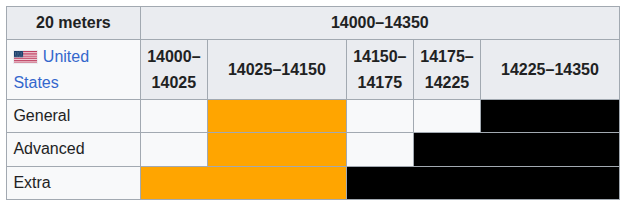
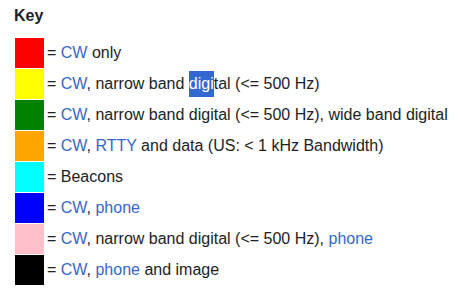
| 14.070-14.095 | RTTY |
| 14.095-14.0995 | Packet |
| 14.100 | NCDXF Beacons |
| 14.1005-14.112 | Packet |
| 14.230 | SSTV |
| 14.286 | AM calling frequency |
7.00-7.300 MHz 40 Meters
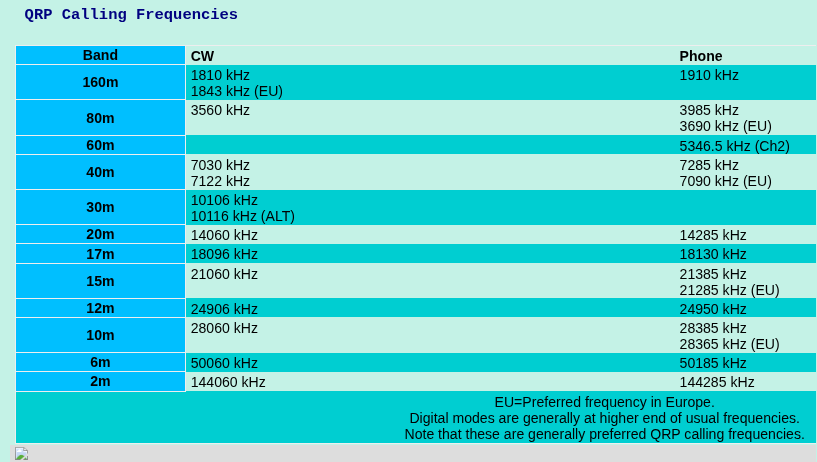
QRP
QRP frequencies—often called "Centers of Activity" (COA)—are specific points on amateur radio bands where low-power operators gather to find one another.
By general amateur radio convention, QRP operation limits power output to a maximum of 5 Watts for CW (Morse code) and 10 Watts for SSB (Phone).